For years, the community in Enfield Borough has been calling for average speed cameras on the A10 Enfield / Edmonton carriageway. The petition in 2019 led to average speed cameras
Lack of action by the Mayor of London and Enfield Council on A10 speeding and Borough car meets – slammed.
Call for action continues…. For years, the community in Enfield Borough has been calling for action to tackle the dangerous A10 speeding, illegally modified cars and unlicensed car meets. Including
UPDATE: A10 Speeding, noise and borough car meets
I continue to work with the Police, Council, GLA/TfL, car park owners and local residents on these issues. Having been pressing for action for six years – appreciate the frustration
Visit to Remus Horse Sanctuary
I was delighted to visit the charity and be toured round by Sue Burton who helped found the Sanctuary. The Remus Memorial Horse Sanctuary provides care for a range of
Save Church Street Recreation Ground – NO to Labour’s Crematorium Incinerator.
We must save Church Street Recreation Ground, Haselbury in Enfield Borough. The Enfield Labour run Council Local Plan includes a proposal for a Crematorium Incinerator there. Video is of me
New approach to mental health announced for young people
For too long there hasn’t been enough focus on mental healthcare in this country, it has been hidden injustice and surrounded by unacceptable stigma, leaving many to suffer in silence. Changing this goes right to the heart of shared values and making sure we live in a country where everyone is supported.
Today, the Prime Minister announced new plans to transform mental health support in schools, workplaces and communities.
There will be new support for every secondary school. Each school will be offered mental health first aid training to increase awareness around mental health and help to tackle the unacceptable stigma around the issue. To support this initiative, new proposals will outline how mental health services for schools, universities and families can be improved, so that everyone in the community is supported, at every stage of life.
As an anti-bullying campaigner I have seen first hand the long term mental health effects that bullying can have on young people and the charities like Red Balloon Learner Centre Group that have done so much to help. I have been highlighting this issue for some time including my article on Conservative Home. This is a welcome step forward.
These proposals are part of a wide range of measures to improve mental health and make sure no one is left behind. There will be an expert review into how we can improve mental wellbeing in the workplace so employees receive more care. There will be more support in the community so everyone in need can access the best support for their needs, more online services will be provided and the system will be made fairer for people suffering from mental health problems.
This is an opportunity to make sure we are providing attention and treatment for those deserving of compassion and help, striving to improve mental wellbeing and ensure that everyone is supported.
The plans that the Prime Minister announced includes:
New support for schools – to support children and young people and help to tackle mental illness early. Every secondary school in the country will be offered mental health first aid training and build stronger links with local NHS mental health staff. To support this, there will also be a major thematic review of children and adolescent mental health services across the country, which will be led by the Care Quality Commission, to identify priority areas. A new green paper on children and young people’s mental health to set out plans to transform services in schools, universities and for families.
New partnerships with employers – to improve mental health support in the workplace. Lord Dennis Stevenson, the long-time campaigner for greater understanding and treatment of mental illness, and Paul Farmer CBE, CEO of Mind and Chair of the NHS Mental Health Taskforce will lead a review on how best to ensure employees with mental health problems are enabled to thrive in the workplace and perform at their best.
Further alternatives to hospital treatments – to support people in the community and recognise that seeing a GP or going to A&E will not be the right intervention for everyone. We will build on our £15 million investment to provide and promote new models of community-based care such as crisis cafes and community clinics. The initial £15 million investment led to 88 new places of safety being created and we will build on this success
Investing in and expanding digital mental health services – rapidly expanding mental health treatment. We will speed up the delivery of a £67.7 million digital mental health package so that those worried about stress, anxiety or more serious issues can go online, check their symptoms and if needed, access digital therapy immediately rather than waiting weeks for a face-to-face appointment. Further follow up face-to-face sessions will be offered as necessary.
Introducing new ways to right the injustices people with mental health problems face – making the system fairer. Despite known links between debt and mental health, currently hundreds of mental health patients are charged up to £300 by their GP for a form to prove they have mental health issues. To end this unfair practice the Department for Health will undertake a formal review of the mental health debt form, working with Money and Mental Health. We will also support NHS England’s commitment to eliminate inappropriate placements to inpatient beds for children and young people by 2021.
Spending more to help people with mental health conditions. In the last Parliament there was a record of £11.7 billion investment in mental health services. In the Spending Review we committed an additional £600 million in mental health to ensure access to talking therapies, perinatal mental health services and crisis care.
Helping millions more people get psychological treatment and recover. The Improving Access to Psychological Therapies programme – backed by £400 million – has treated over 2.6 million people, and over 1.5 million have completed that treatment. Over 1 million people have reached recovery. The total number of people helped in the last Parliament from talking therapies was 3 million, compared to just 226,000 people helped in the Parliament before that—a thirteenfold increase.
Supporting new and expectant mums and their babies to be happy and healthy. We are investing £290 million to ensure at least 30,000 more women each year will have access to mental healthcare. Women will have access to perinatal classes, new community perinatal teams, more beds in mother and baby units and improved mental health support.
Introducing waiting time standards so people get treatment for mental health conditions sooner. We have introduced the first ever access and waiting standards for mental health services and those standards are being met. We have introduced the first-ever waiting time for teenagers with eating disorders, from 2017/2018 they will be seen within a month of referral or within a week for urgent cases.
A housing strategy to help those in need
 Ask any Member of Parliament or Councillor what their biggest issue of casework is, and invariably it will be housing need.
Just like the free market reforms of the 80’s ensured the dream of home ownership was realised for millions of people, so must we have the same ambition to give people the security and stability of owning their own home to the many.
Although any strategy must move with the times and the solutions of the past are not always the same as today.
The Government has doubled the housing budget to more than £20 billion over the next five years coupled with the largest house  building programme by any government since the 1970s.
Supporting people who work hard and play by the rules, to achieve their dreams of buying their own home is a key part of our long term plan to deliver an economy that works for everyone, not just a privileged few.
How can this be achieved?
The Government’s strategy is:
(1) Delivering 400,000 new affordable home starts by 2020. Including doubling the housing budget and are investing £8 billion to build 400,000 affordable homes, including quality homes for rent.
(2) Extending Right to Buy to housing associations tenants – ending the unfairness that allowed only council tenants to use Right to Buy. Under the reinvigorate Right to Buy councils are already providing one extra home for each additional property sold and housing associations have committed to provide an additional home for each property sold under Right to Buy on a one-for-one basis.
(3) Passing the Housing and Planning Act – making it easier to build homes and improving the private rented sector. Pay-to-stay means council tenants earning over £40,000 in London and £31,000 elsewhere will pay fair rent.
(4) Launching London Help to Buy and Help to Buy: ISAs – helping people save towards their first home. The London Help to Buy scheme allows Londoners to buy a home with just a 5 per cent deposit and a mortgage as low as 55 per cent. First-time buyers will be able to save up to £200 a month for a deposit that the government will top up by 25 per cent, up to a maximum of £3,000.
(5) A £3 billion Home Building Fund to help build more homes. We are offering direct support for those who cannot access financing in the market. £1 billion of short term loan funding will be for small builders and custom builders, delivering 25,000 homes this Parliament and £2 billion of long term funding will be for infrastructure and large sites, unlocking a pipe line of up to 200,000 homes over the longer term.
It is worth remembering that housebuilding under Labour fell to levels not seen since the 1920s. Between June 2008 and June 2009 only 75,000 new homes were started, the lowest level of housebuilding in peacetime since the 1920s.
Only the Conservatives can deliver the homes that are needed.
Cambridge to Oxford ‘Varsity’ Train Line back on track
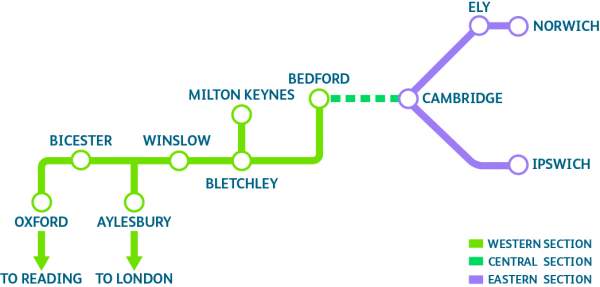
Calls to reintroduce the Cambridge to Oxford Train Line, known at the ‘Varsity Line’ received a boost this week. In the Chancellors statement he announced that the Government would provide £110m of funding for an east-west rail link between Oxford and Cambridge. Of this £100m would be spent accelerating the building of Western Section, which includes the Bedford – Oxford and Milton Keynes to Aylesbury lines.
Then the remaining £10m would be used to identify a preferred route for the line to extend east of Bedford, via Sandy, to Cambridge.
The Chancellor, Philip Hammond MP said,  “This project can be more than just a transport link. It can become a transformational tech-corridor, drawing on the world-class research strengths of our two best-known universities.”
The original ‘Varsity’ line to Sandy was closed in 1967. Sadly reopening old route is not possible as the line was dismantled and used for other purposes including the Ryle radio telescope array and housing for instance.
Aside from the economics and boosting this high tech corridor, the concept of any resident being able to travel from Cambridge to Oxford in an hour has to be an exciting one. I for one look forward to the day when this vision is realised, and sooner rather than later. This is now a deliverable scheme and every effort must be made for it to become reality as soon as possible.
Expanding the dream of home ownership
Speak to any Member of Parliament or Councillor and they will tell you one of the biggest issues in their in tray of residents trying to get onto the housing ladder.
Expanding this dream to the many must be a priority in our nation. The Government has a stated ambition to create one million more homeowners and to help have doubled the housing budget to more than £20 billion over the next five years coupled with the
the largest house building programme by any government since the 1970s.
This includes:
(1) Delivering 400,000 new affordable home starts by 2020. We have doubled the housing budget. (2) Extending Right to Buy to housing associations tenants – ending the unfairness that allowed only council tenants to use Right to Buy. Housing associations have committed to provide an additional home for each property sold under Right to Buy on a one-for-one basis.
 (3) Granted automatic planning permission in principle for brownfield sites and councils
have a duty to allocate land for homes for 20,000 custom and self-built homes a year by 2020.
(4) Launching London Help to Buy and Help to Buy: ISAs – helping people save towards their first home. Allows Londoners to buy a home with just a 5 per cent deposit.
(5) £3 billion Home Building Fund to help build more homes. Offering direct support for those who cannot access financing in the market. £1 billion of short term loan funding will be for small builders and custom builders, delivering 25,000 homes this Parliament and £2 billion of long term funding will be for infrastructure and large sites, unlocking a pipe line of up to 200,000 homes over the longer term.
This strategy will go a long way to boosting the housing supply that the previous Labour Government seemed unable to do, with housing delivery at certain points being the lowest since the 1920’s.
It is right that everything is done to ensure those wanting to get on the housing ladder can.
Increasing medical training in the NHS
 The Government has committed to making the NHS in England self-sufficient in doctors by opening up medical training to many more people in our country.
It is right that the NHS is always, free at the point of delivery, when you need it and so ensuring the NHS will always have the doctors it needs.
 The plan is to increase the number of medical student training places in England by up to 25 per cent – from 6,000 to up to 7,500 – to ensure the NHS is self-sufficient. Alongside this there will be an obligation that those students who benefit from a taxpayer subsidy for their medical studies are required to work in the NHS for at least four years after leaving university.
It cannot be correct for their to be a cap on the number of medical training places in England. Half of applicants are turned down and denied the opportunity to undertake a medical degree because the number of medical student places is artificially limited to 6,000 a year.
Currently the NHS is spending growing amounts of money on agency staff – when this money could be going on patient care. Last year hospitals spent £3.3 billion on agency staff, including £1.2 billion on medical locums.
Only the NHS is safe with the Conservatives:
• Increasing funding for the NHS by £10 billion a year by 2020, of which £6 billion will be delivered by the end of 2016-17. The NHS budget will rise from £101 billion today to £120 billion by 2020-21.
• Delivered almost 8,800 more doctors and almost 5,600 more nurses and midwives in our NHS compared to 2010.
• The NHS performed 4,400 more operations a day and treated on average 21,000 more out-patients a day last year compared to 2010.
Supporting our Armed Forces – Help to Buy Extension
 The Conservatives launched the Forces’ Help to Buy scheme in April 2014. This was aimed at helping members of the Armed Forces afford a deposit to buy their first home. Already this has ensured that 10,000 personnel have already been successful. For many being able to have a home of their own is a dream come So the Government is now extending the scheme until 2018 so that more can benefit.
It is worth remembering that fewer than half of the Armed Forces own their own home. Overall home ownership rate in he Armed Forces is around 47 per cent. Amongst non-officer other ranks such as non-commissioned officers, warrant officer ranks and below only 40 per cent own their own home, falling to only 30 per cent for other ranks in the Army.
Our Armed Forces keep us safe and we are committed to giving our service personnel and the unsung heroes – their families – the support they want in return for all they do for our country. So extending this scheme more troops will get this extra help, they will be able to give  their families the stability that many of us take for granted.
Conservatives enshrined the Armed Forces Covenant in law and are strengthening it by doubling operational allowances and abolishing council tax relief for Forces on operations; spending over £1 billion providing better accommodation for Service personnel, which includes 2,000 new homes and over 8,000 new single rooms, and improving healthcare provision and mental health support for veterans.
Strike to cost London economy £100 million
 The latest strike over five days will be the longest in 50 years. It is estimated that it will cost the London economy about £100 million.
This will be on top of the misery caused for hundreds of thousands of commuters.
Incredibly the strike came about due to just 306  union members voting for it. Equating to over £300k lost to the London economy per union member.
Some conductors did break the picket line and ensure that the travelling public was put first.
That is why the new Trade Union Act strike law is so important. Which will include a 40 per cent  support threshold for industrial action in so important in key public services such as fire, health, education, transport, border security and nuclear decommissioning. The thresholds still ensure the right to strike, but also that is fairly balanced with the right of people to be able to go about their daily lives and work. This legislation is in the process of being implemented in stages.
On Monday just over half of Southern Rail’s normal timetable ran to time.
Today the rail firm Govia Thameslink invited the RMT union to talks ‘any time, any place, anywhere’.
People going about there normal lives, trying to get to work should not have to endure the misery that they have.
Bold new agenda to tackle modern day slavery
 The Prime Minister is setting out a bold new agenda with the first ever government task force to tackle modern slavery.
There is no greater injustice than that of modern slavery that takes place across our Country. Vulnerable people, who have often travelled across continents and oceans in the hope of a  new life are duped, forced into hard labour, locked up and abused.
Part of the strategy is to make sure that all police forces treat this crime with the priority it deserves and work with other law-enforcement agencies across the world to track and stop organised gangs who operate across territories and 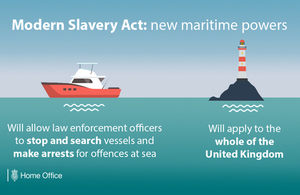 jurisdictions.
It was Britain that took an historic stand to ban slavery two centuries ago, so Britain will once again lead in defeating modern day evil of slavery and uphold the freedoms and values that define modern civilised society.
The Government will:
 (1) Set up the first task force on modern slavery. Chaired by the Prime Minister and Home Secretary, the task force will co-ordinate departments across Whitehall to tackle exploitation.
(2) The first Anti-Slavery Commissioner is working on intelligence with other countries  and has already uncovered criminal gangs creating modern slavery between Britain and other nations.
(3) Crack down on modern slavery abroad with a five year International Modern Slavery Fund. Total of £33 million will focus on high risk countries, where victims are regularly trafficked  to the UK.
This is in addition to the introduction last year of the first Modern Slavery Act. Including tough new penalties to put slave masters behind bars. The Act prevents anyone convicted of trafficking to return to countries where they have previously exploited vulnerable people and requires businesses to show that modern slavery is not taking place in their companies or their supply chains.
Together we must end this modern day evil.
Why we must maintain our nuclear deterrent
 For any Government, there is no greater responsibility than ensuring the safety and security of it’s people.
We live in a very unpredictable world. Without a deterrent could potentially leave us in a vulnerable position.
Trident has afforded us a nuclear deterrent for nearly 50 years, with a British submarine carrying  nuclear weapons – always on patrol.
The argument for Trident is that even if our conventional defence capabilities were destroyed, we would still be able to launch a retaliatory strike on an aggressor.
Once nuclear weapons have been given up it is almost impossible to get them back – and the process of creating a new deterrent may take decades. That is why the Conservative Party committed to renewing the Trident nuclear deterrent in it’s manifesto.
Some have said that we do not need to make a decision now. Whilst it is true that Trident has many years of use left, they cannot last  indefinitely. Our current generation of four submarines would begin to end their working lives some time in the late 2020s.
Work on a replacement cannot be delayed because the submarines alone could take up to 17 years to develop.
To disarm would be a dangerous risk that would weaken our allies and strengthen our enemies. A gamble with the safety and security of families in Britain that we must never be prepared to take.
The nuclear defence industry is also a major UK employer. It is estimated that up to 15,000 jobs may be lost if a new submarines are not commissioned. In addition to the unique skills required.
In an uncertain world, we must maintain our deterrent defence posture – not weaken it.
Postgraduate Masters in Law – 1st year passed
 Delighted to report that today I passed the first year of my Postgraduate Masters in Law (LPC LLM) studies.
Which has included; Criminal Law, Civil Litigation, Employment Law, Property Law and Solicitors Accounts.
This follows on from being the first person in my family to go to University, successfully securing in 2015 a Bachelor in Laws (LLB) undergraduate degree at Anglia Ruskin University in Cambridge.
It has opened up a whole new world to be and taking the next step on the path with the University of Westminster has been an exciting one in starting the second qualification.
I will enjoy the break, ahead of recommencing the final year of the Masters in Law in September!


